





Someone has asked you for a bond. Perhaps it is written into a contract you are about to sign, or a council has made it a condition of adopting your roads. Either way, you now need to understand an instrument you may never have used before.
The good news is that the core idea is simple. Most of the confusion comes from the word “bond” being used for several different things in finance, and from surety being repeatedly described as insurance when it is not.
Here is what a surety bond actually is.
The basic idea
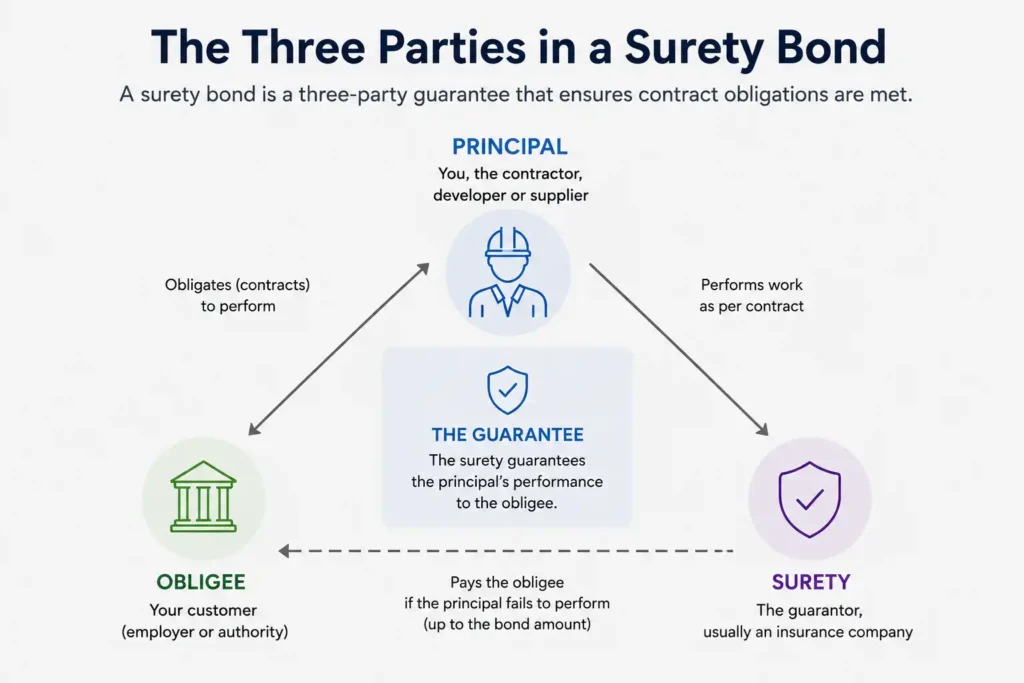
A surety bond is a written guarantee that you will do what your contract says you will do. If you do not, the guarantor pays your customer.
Three parties are involved:
- The principal – you, the contractor, developer or supplier who has to perform.
- The obligee – your customer, usually called the employer, or a local authority.
- The surety – the guarantor, normally an insurance company, that stands behind you.
If you perform, nothing happens. The bond expires and everyone gets on with their lives. If you fail, the obligee can claim, and the surety pays up to the value of the bond.
That is the whole mechanism.
Why a surety bond is not insurance
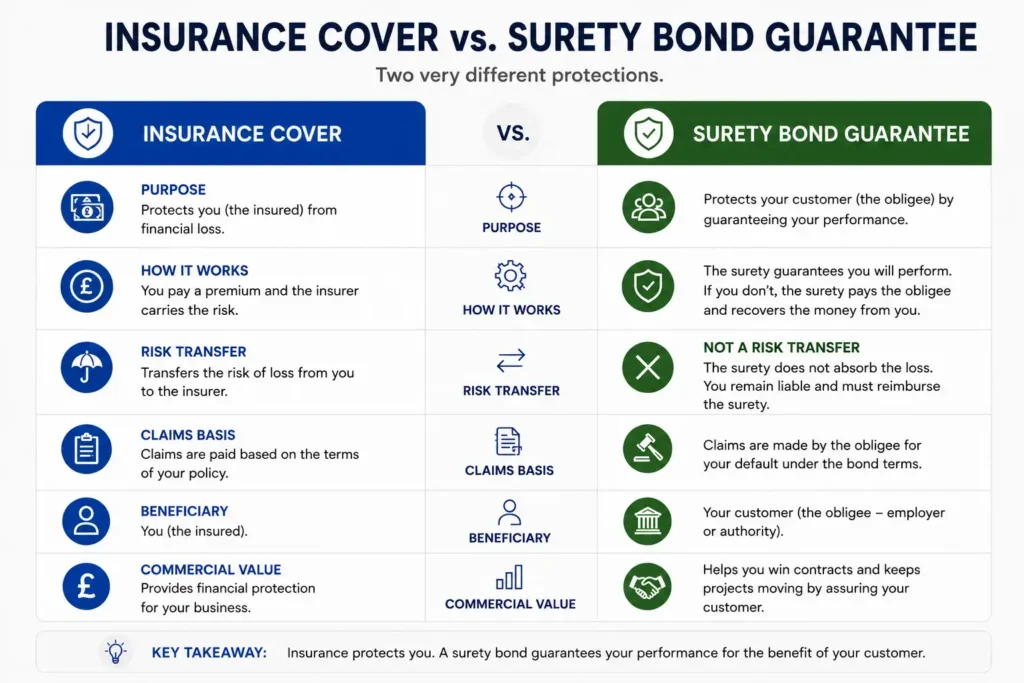
This is the point most worth understanding, because it changes how the product behaves and how it is priced.
With insurance, you pay a premium and expect the insurer to carry losses. The insurer prices on the assumption that a proportion of policies will produce claims.
With surety, the guarantee is given to someone else, for their benefit, and the surety expects no claim at all. It underwrites you on the basis that you will complete the job.
There is a second consequence that surprises people. A surety bond is not a transfer of risk. If a bond is called and the surety pays out, you owe the surety that money. The surety takes a deed of counter-indemnity precisely so it can recover from you.
So a bond does not protect you. It reassures your customer, which is what allows you to win the contract in the first place. That is its real commercial value.
How it works in practice
Take a contractor awarded a £2 million contract that requires a performance bond.
- The contract specifies a bond, commonly set at 10% of the contract value – so £200,000.
- The contractor applies through a broker, who approaches surety markets with the accounts and contract details.
- The surety underwrites the contractor’s financial strength and track record and quotes a premium.
- The bond is issued before work starts, in favour of the employer.
- The contractor completes the job. The bond expires at the date in the wording, usually practical completion or the end of the making good of defects period.
The £200,000 is a ceiling on the surety’s liability. It is not money that changes hands unless something goes wrong.

The main types of bond
Different obligations call for different bonds. Our surety bonds overview covers the full range, but these are the ones most UK businesses meet.
Performance bonds – the most commonly requested. They guarantee the contractor will complete the works as agreed, and compensate the employer if not.
Advance payment bonds – used where the employer pays up front, often so the contractor can buy materials. The bond protects that payment if the goods or services never arrive.
Retention bonds – instead of the employer holding back a percentage of each payment, the contractor provides a bond. The employer keeps its security, and the contractor keeps its cash. On a long contract, the working capital effect is significant.
Road and sewer bonds – also called section bonds. Local authorities and water companies require these before adopting new roads and sewers, guaranteeing the developer will build them to an adoptable standard.
Bid or tender bonds – provided with a tender to demonstrate that if you win, you will actually enter into the contract.
There is also the insurance-backed guarantee, which adds a further layer behind a guarantee the contractor has already given, covering the customer if the contractor stops trading.
On-demand or conditional: read the wording
Two bonds can carry the same value and behave completely differently when called.
A conditional bond pays only on proven, quantified loss. The employer has to establish that you defaulted and what that default cost. The ABI-style bond widely used with JCT contracts works this way, and it is generally regarded as the fairer arrangement for both sides.
An on-demand bond allows the employer to call it without proving anything. The surety pays, and you argue about it afterwards, having already lost the money.
NEC contracts and solicitor-amended wordings vary considerably. Never assume the bond in front of you is the balanced one. Have the wording reviewed before you sign, not after a dispute starts.
What bonds cost
You do not pay the bond value. You pay a premium, which is a percentage of the bond value.
For performance bonds, the general guide is 3% to 10% of the bond value, depending on project value, your trading history and the security required. On a £200,000 bond, that is roughly £6,000 to £20,000. Rates differ by bond type – advance payment bonds, for example, are priced against a different risk profile.
The premium is a fee, not a deposit. It is not refunded when the bond expires without a claim.
What underwriters actually look at
Because surety is underwritten on you rather than on the project, the assessment is mostly financial.
- Filed accounts – current, professionally prepared, showing reasonable working capital and net worth.
- Trading history – evidence of completing similar work to time and budget.
- Claims record – a clean history is worth real money.
- The bond wording – on-demand exposure is underwritten more tightly than conditional.
- Contract duration – a bond running to the end of the defects period holds the surety’s exposure open longer.
Newly formed companies, joint ventures and special purpose vehicles can still be bonded. Expect a higher rate, or additional security, until there is a track record to look at.
Who needs one, and why more people do
Bonds are common in construction, engineering, property development, supply agreements, waste management and public procurement. Anywhere a customer is exposed if a supplier fails, someone will ask for security.
Demand has risen for an obvious reason. Construction has been the worst-affected sector in the UK insolvency figures for some time: in the 12 months to June 2026 it recorded 3,805 company insolvencies in England and Wales, more than any other industry. The Insolvency Service publishes monthly figures on GOV.UK.
That has two effects. Employers ask for security more often. And offering a bond proactively, even where the tender does not demand one, has become a genuine way to stand out against competitors who cannot.

Where to start
If a contract in front of you requires a bond, the useful first steps are to check what type is specified, read the wording, and get an indicative cost before you price the job.
Aedis Surety arranges bonds through insurance-backed surety markets rather than bank facilities, which means your banking lines stay free for trading. Our FAQs answer the questions that come up most often, and you can contact the team to talk through a specific requirement.